Saturday, April 19, 2014

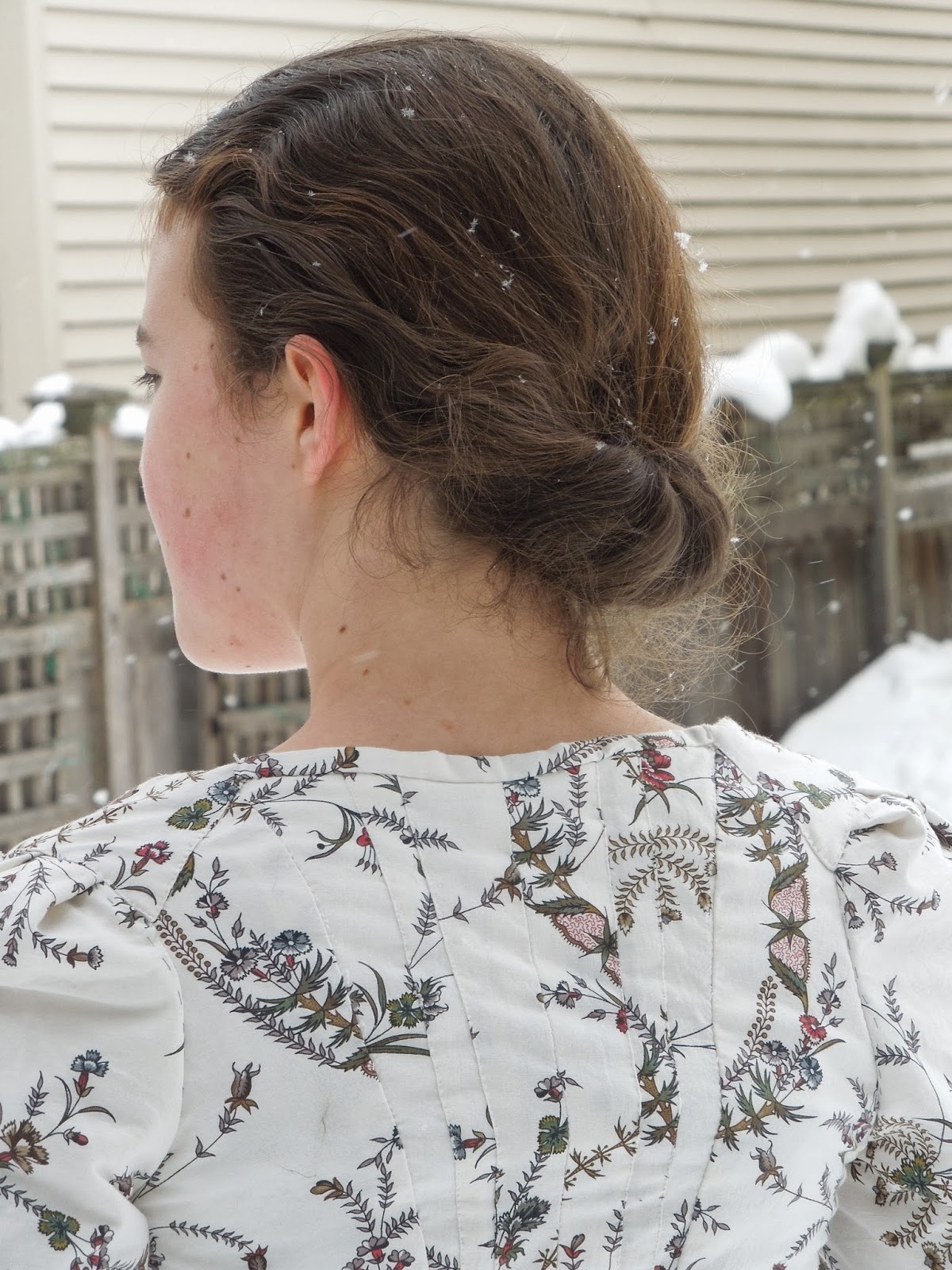
A very Easter-ey dress

Proving, to my surprise, that 1770s fashion is considerably more comfortable than 1860s.
Also, in which I need to remember to buy more hooks and eyes at some point because I ran out.  Please do excuse the resulting fitting issues...
Just the facts:
Fabric:  Gorgeous tropical weight wool from Vogue fabrics. It's as soft and sheer as cotton voile, and at first I was so reluctant to make it into a 1770s dress rather than a summer Civil War sheer.  But I'm glad I did, because it's insanely light and comfortable.
Pattern: JP Ryan, as usual, altered to make a jacket instead of a polonaise. 
Time: About two weeks. We're having our house painted and I have finals coming up, so it's been pretty hectic at home.
What I learned/would change:  I'm definitely going to put some pleated trim on this and bone the back (it's so wrinkly I don't dare show pictures of it.) Also, the jacket is short in the back so the ruffle sticks up like a duck butt. It's not very attractive.  And of course, I need some hem tape. And I think the sleeve pleats are a bit too far forward, but that's my fault for being to lazy to put it on my dress form.
Me tripping (thanks, dad.)
I think the colors are very Eastery.  I'm going to put linen ruffles on the sleeve and put the hooks and eyes on for real before I wear it, but I'm pretty happy with it now.

Sunday, March 30, 2014

Pretty in Blue

After the trial that was acquiring the right fabric in the perfect-ish shade, the harrowing experience of applying the lace, and then realizing that the bodice needs to be re-fitted, I'm pretty happy to be done with this dress.

And now, shameless self-aggrandizement via pictures.

Maman lent me her mother's pearls for the photos!

My bubby.
As you can see, the bodice suffers to be taken in a bit at the front.
Serious side-eye action.
Just the Facts:

Period:  Mid-1860s

Pattern: Janet Arnold's 1860s ballgown, and a lot of fudging it.  The skirt is box pleated and the sleeve us a normal puff sleeve, but I tacked it down in random places to make it look interesting.

Fabric:  Silk taffeta, white cotton lining, antique lace, cotton organdy, silk ribbon, velvet rayon ribbon.

Time:  Once I got the fabric, about a week and a half.  But lordy, what a challenge that was!

Verdict:  Meh.  It is exactly what I had expected it to look like.  I'm going to seriously refit the bodice before I wear this in public.  This is my first time making a dress with princess seams, and the finished garment behaved very differently than my poly taffeta mockup, unfortunately.  Luckily, I know what I need to do, I'm just too lazy to do it.

I'm also tepid about the concept of using antique lace for this dress.  I found this lace a few summers ago in a Michigan antique store for $5 with a few similar pieces, and I tried to be as careful as possible and used the strongest of the pieces.  That being said, I believe there's a special circle of hell for those who use and abuse antique clothing and I don't want to end up there, as the last thing that I want to do would be to ruin this gorgeous lace.  So I might take it off as a precaution...

Anyways, I have another modern dress in the making, so I'll probably post that soon.  Until then!

Wednesday, March 26, 2014

Love from the Underwoods

Or, experiments with online patterns.

As it turns out, sewing modern clothes can actually be pretty rewarding!

I was inspired by Netflix's masterful drama House of Cards (imagining a modern jacksonian political tv show while watching it;) more precisely, Claire Underwood's on point wardrobe:
So on point.
 And my take!

Just the facts:

Pattern: Burdastyle reverse pleated dress; I was drawn to it by the pleats that look like an en fourreau back.

Materials:  Strangely expensive? cotton pique, cotton thread and a miscellaneous zipper

Time:  About 5 hours (no, really, this was really quick!)

Opinion?:  Really great!  I'm going on a summer trip with a good friend of mine, so I wanted a cute but relatively modest summer dress.  A few considerations:  this dress is supposed to have sleeves, but me with my peasant laborer arms to not to well with standard sleeve sizes and I was too lazy to redraft the pattern; the side darts are really asymmetrical and need to be re-done at some point, and the whole thing needs a good ironing and de-linting.

Other than that, though, I feel pretty sassy and ready to take over Washington alongside my husband (played, obviously, by Kevin Spacey.)


It's only one layer, with pleats all around.  So basic, but so nice.  How I'm going to keep it white is beyond me.

 And then with a cute thrifted bolero to hide ungainly side darts:
I already stopped by my favorite fabric warehouse after a particularly grueling harp performance and picked up a dress length of wool blend that looks like it came out of Hannibal Lecter's closet for another rendition of this pattern (the new Hannibal, of course, not Silence of the Lambs Hannibal.  Ew.)

And because this is a historical sewing blog, here is a sneak peek of my finished dress (which will be photographed in earnest once my darling photographer comes home.  Hop on to my tumblr blog if you want to see more shots on my terrible mannequin.)

Until later!

Sunday, March 16, 2014

Radio silence

I apologize for the recent lack of updates, friends!  I'm not dead.  I've just been working on little things and repairs (I made an underpetticoat and also made up the cotton print 1770s petticoat.)  I expected to get my fabric in a lot earlier than I did, but because I had to send the first batch back I was set back in my schedule.  But I'll have something very, very cool to show off soon.

In the interim:  If I started making little things, like aprons, sleeve ruffles, chemises, petticoats, and maybe larger custom orders, who would be interested?

c:

Saturday, February 22, 2014

Reduce, reuse, re-sew

 So... While waiting for new fabric to come (neeheehee) I decided to take care of some long-needed refurbishments in my existing wardrobe.  First up, my black silk Douglas Day dress.  You all remember that? It was so small at the bust I had to turn it down into a v-neck, the waist was too large, the back to narrow and the sleeves were too tight and ill fitting.
And... Now!  (ignore the lack of undersleeves and my petti kicking out the skirt at the sides, merp.)
I took in the waist substantially, let out the back seams and overstitched them to compensate for how creased they were.
I then entirely re-did the front, taking off the hooks and eyes tacked there and replacing it with the hidden hook-and-eye application method, as well as adding buttons down the front to add visual interest.  I also had to take off the neck piping and cut the neckline down because it was too small at the back.
And then, lastly, I re-did the unsalvageable sleeves, as I was lucky enough to have enough fabric left to make new ones.  The only trim on them is a line of narrow black velvet.

The bodice is not basted to the skirt yet, which explains some of the strange fitting issues in these pictures as the bodice is quite high-waisted on me (it's from an extant pattern from before I knew how to make successful mockups.)
 And then I took official photos of my altered paletot - I switched the collar to a standing one, tried to neaten up the shoulders, re-applied the fur trim and added the big fur cuffs.
There is still some work that has to be done on this before it's in truly wearable condition (or, wearable with pride) but for now I'm happy that I was able to save an old project instead of starting a new one.
But speaking of new projects....

*maniacal laughing*
Guess what I just bought fabric for....

Monday, February 17, 2014

Revwar basics

Yes, still kitting up, as it were.  Bit by bit.
 Ignore my (admittedly pretty quality) AP Euro t-shirt.
I actually made this last week in a day and a half, which is pretty impressive given my record of procrastination.  We were driving down to Springfield to see the Lincoln Museum, which was a wonderful trip wherein I took selfies with Robert Todd Lincoln, but that's a whole different story.
 The entire cap is one layer, as is correct (instead of double layers with the caul and ruffle sandwiched inbetween)
 The kind of sloppy whipped gathers - each piece was individually hemmed with a rolled hem and then the ruffles were drawn together using the thread from the hem.
 The drawstring at the neck.
The view from the top!

I used Kannik's Corner's mob cap pattern with some very fine linen and cotton tape that I got from Reenactorfest, and will definitely be making a few more of these for Williamsburg (maybe one with a double ruffle, or a pleated ruffle.)

Now I'm on the last leg of refurbishing my black silk 1860s dress and I've rec'd a good amount of royal blue silk taffeta as a present for that blue ballgown that I've been dreaming of ever since I found all of that antique chantilly lace at a thrift store in Watervale.

Hopefully when I'm done with them it won't be too snowy out to take pictures!

Saturday, February 8, 2014

My first 'good' dress

Naught but the most quality selfies in 3 feet of northeastern snow.
I finished my second Revwar dress this week, which I'm pretty gosh darn proud of.
 Just the basics:
Year: Roughly 1770
Fabric: Williamsburg collection cotton print, linen lining, petticoat of unknown and unknowable organic origin, cotton and linen thread.
Pattern: My usual JP Ryan pattern
Time:  About a week and a half, working all day in class, entirely handsewn.
What I would change:  I might re-set the sleeves, but at least they're long enough.  And I want to re-do the pleats and make them smaller, and make a matching petticoat if I have enough fabric left.

I also went to Reenactorfest last weekend, which was an absolute blast- I wish that I'd brought my camera, but we had all sorts of high-energy fun and met some wonderful people, and I spent a lot more than I should have.  For instance, this lovely (and unironed) short cloak, a lot of period makeup from the lovely litttlebits, and a lot of fabric, notions and patterns from various and sundry sources.

And here are some detailed shots of the dress itself as a closing statement:
 The inner lining with the en fourreau pleats tacked down
 The skirt pleats, which are tacked on then overstitched.
The shoulder-piece, which is overstitched down on top of the sleeve cap.  (and also a bit of basting thread, whoops.)